
What is a Turing Test?
In 1950, computer science pioneer Alan Turing proposed a thought experiment that has shaped how we think about artificial intelligence ever since. His question was elegantly simple: Can machines think?
Rather than getting tangled in philosophical definitions, Turing proposed a practical test. A human judge engages in natural language conversations with both a human and a machine, without knowing which is which. If the judge cannot reliably distinguish the machine from the human, the machine is said to have passed the test.
The Turing Test became the gold standard for evaluating machine intelligence. Not by measuring what a computer knows, but by how convincingly it can communicate like a human.
"I propose to consider the question, 'Can machines think?'" — Alan Turing, 1950
The Inspiration
TuringDuel is inspired by a fascinating piece of research: "A Minimal Turing Test" by John P. McCoy and Tomer D. Ullman, published in the Journal of Experimental Social Psychology.
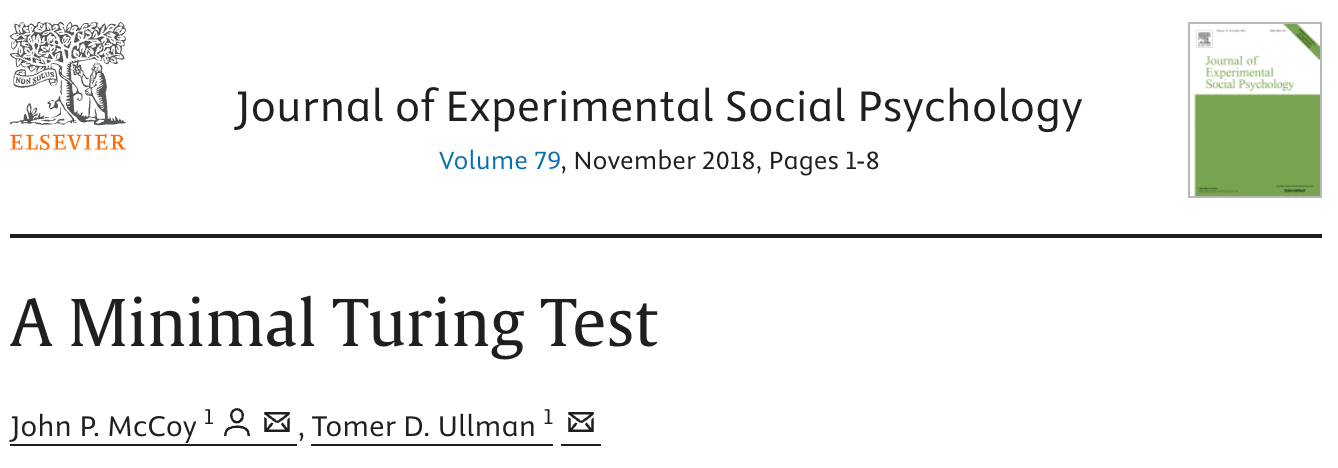
The researchers asked a deceptively simple question: If you had to prove you were human using just one word, what would you pick?
Their findings were remarkable. People gravitate toward words that feel distinctly human: words tied to emotions, bodily experiences, and cultural nuances that (at the time) seemed beyond the reach of machines.
"Love" was the most common answer. Humanity, it seems, instinctively reaches for what makes us feel most alive.
From Paper to Game
The Minimal Turing Test is brilliant, but a single word felt too... minimal. One-off would be boring! So we turned it into a multi-round duel where each choice builds on the last.
Ideally, we'd have human judges deciding whose word is more "human." That would be fascinating, and fun! But coordinating real-time human judges at scale is hard. So for now, AI judges evaluate each round. (There's something deliciously ironic about an AI judging which word is more human.)
The result is TuringDuel: a game where you compete against AI in real-time, trying to out-human a machine that's getting better at pretending to be human every day.
The Big Questions
With TuringDuel, we have a unique opportunity to explore some genuinely interesting questions at scale:
Are some humans better at "playing human" than others?
What makes someone good at this game? Creativity? Unpredictability? Emotional intelligence? We're curious to find out.
Which AI models are best at pretending to be human?
Different models have different strengths. Some are more creative, some more predictable. By pitting them against human players, we can see which ones are most convincingly "human."
Who wins: humanity or AI?
Across thousands of games, do humans prove their humanity more often than not? Or are we already at the point where AI can fool an AI judge just as well as we can? The data will tell.
Why It Matters
We're living through a remarkable moment in history. Large Language Models are becoming increasingly sophisticated, blurring the lines between human and machine communication in ways we couldn't have imagined a decade ago.
TuringDuel is a playful way to engage with this reality. It's a game, yes, but it's also a mirror. When you choose a word to prove your humanity, you're asking yourself: What makes me human?
And every game you play adds to our collective understanding of how humans and AI think differently, or don't.
Lastly, the Irony
I wouldn't have been able to build this game and give it this level of attention or effort if it wasn't for... AI. The tools we have available at our fingertips today are truly remarkable and the game would have taken me months instead of weeks to build. And it wouldn't have been nearly as feature-rich, allowing me to pay attention to details and focus on testing. If you do find any bugs, those are on me.
Thank You for Playing
Seriously: thank you. Every game you play contributes to something bigger than just a score on a leaderboard. We're curious about what we'll learn from watching humans and AI compete at being human.
So keep playing. Keep being creative. Keep being human. We can't wait to see what the data reveals.
Ready to prove your humanity?